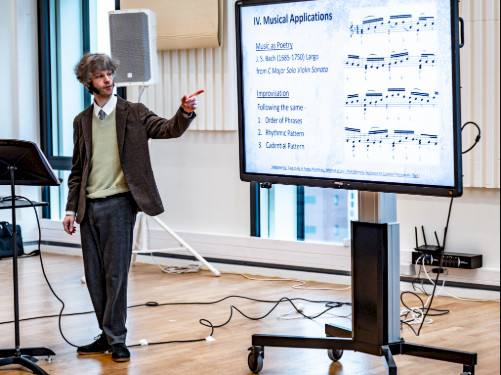
Study day lectorate Music, Education & Society
Study day with Bernard Lanskey, Lies Colman, and the lectorate Music, Education and Society research group of the Royal Conservatoire, with presentations of ongoing research projects and discussions on the complex and ever-changing role of different forms of heritage in higher music education. Guests welcome!
Programme
09:00 - coffee
09:30 – Presentation Lies Colman
09:55 – Presentation Bernard Lanskey
10:20 – Q&A Bernard/Lies
10:45 – coffee break
11:00 – Presentation Suzan Overmeer
11:30 – Presentation Orsolya Toldi
11:45 – Presentation Joost Geevers
12:15 – Q&A Suzan/Orsi/Joost
12:45 – lunch break
13:45 – Presentation James Hewitt
14:15 - Presentation Michela Amici
14:30 – Presentation Guy Livingston
15:00 - Q&A James/Michela/Guy
15:30 – coffee break
15:50 – Presentation Loes Rusch (including discussion)
16:35 – Presentation Riccardo Marogna
17:05 – Presentation Pepe Garcia
17:35 – Q&A Riccardo/Pepe
18:00 – drinks
Lies Colman
Pioneering in practice: Creative agency in performance (education)
In a rapidly changing cultural landscape, musicians are called upon not only to interpret works, but also to create, transform, collaborate, and actively shape new artistic experiences. This shift challenges the hierarchical and reproduction-oriented models that have long underpinned higher music education. Yet despite widespread recognition of these changing demands, their implications for conservatoire curricula and pedagogies have only been partially embraced.
How can institutions move beyond models centred primarily on transmission and reproduction, and instead create conditions in which curiosity, experimentation, risk-taking, and creative decision-making become integral to musical training? How can performers be empowered not only as interpreters of musical heritage, but also as artistic agents capable of shaping the future of the field?
For conservatoires with a strong artistic heritage, a commitment to innovation, and a belief in the transformative role of research, these questions are becoming increasingly urgent. The time may be right to articulate and embody a more expansive vision of classical musicianship—one that honours tradition, craftsmanship, and the canon, while equipping the next generation of artists with the confidence, responsibility, and creative agency to shape the music of tomorrow.
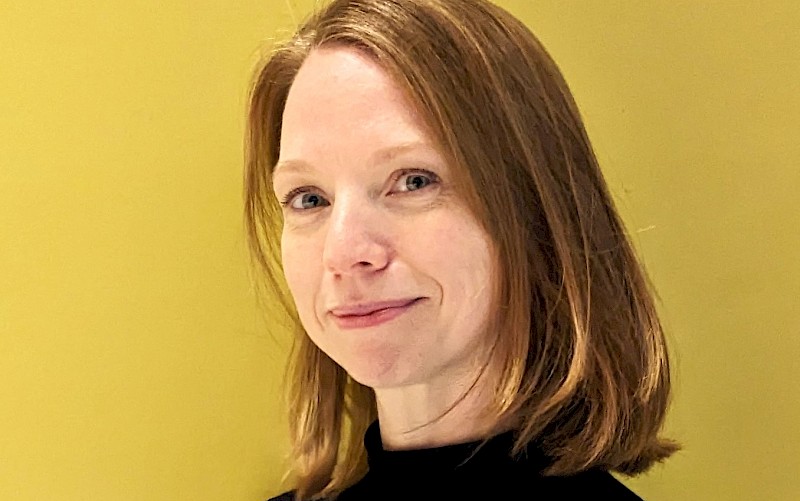
Lies Colman studied piano, violin, percussion and mandolin from a young age and graduated summa cum laude from the National Music Academy of Antwerp. She pursued advanced studies at the Royal Conservatory of Antwerp, alongside academic studies at the Universities of Antwerp and Ghent, where she obtained degrees in Law and Comparative Cultural Studies. She later completed a Master’s degree in Music at the Royal Conservatory of Antwerp. Since 2013, she has served as Visiting Professor of Piano at the Royal Conservatory of Antwerp and has held leadership roles within its Educational Master of Music and Classical Music programmes. She is currently the director of the Royal Conservatoire The Hague. In addition to her artistic work, Colman earned qualifications in Strategic Management and Leadership (2020) and an MBA (2021), before undertaking a Doctorate in the Arts at the University of Antwerp and the Royal Conservatory of Antwerp. Her research focuses on creative and interdisciplinary collaboration, contemporary creation, and innovative artistic practices within the arts.
Bernard Lanskey
Currents of Change
The thought piece "Currents of Change" was originally inspired by the AEC's Artemis explorations around what might need to be questioned if we are to strengthen the place of music in contemporary society. What began as a philosophical questioning has since become something more of a personal reckoning. Having stepped away from institutional leadership after 35 years, I am returning to the piano as the primary voice with which I seek to add value. As such, I find myself revisiting the essence of my undergraduate existential dilemmas, now with the lens of someone in their sixties where the surrounding world has also evolved substantially such that I wonder if we are truly 'in time' with the wider world.
The session will offer some initial provocation for collective reflection and questioning around issues of identity, time, and place. The thesis builds from the attached paper by proposing that there may be pedagogical value to our ongoing self-questioning being visible to students. As such, our artistic research may offer students inspiration of equivalent value to more traditional points of curriculum focus. Dare we share our stories?
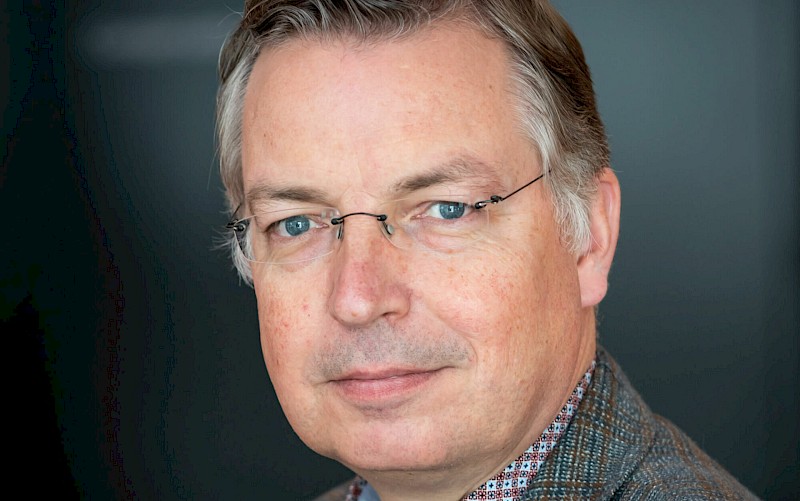
Across more than three decades, Bernard Lanskey held senior leadership roles in London's Guildhall School, Singapore's Yong Siew Toh Conservatory, and Australia's Queensland Conservatorium – all schools with longstanding connections to the Royal Conservatoire. Now returning more intensively to the piano and artistic research, he seeks to offer small personal and collective projects that might gift pathways for deepening human connections through shared music-making. Current projects explore the mercurial relationship between music and memory, cultural and disciplinary intersectionality, and the relationship between agency, identity, and truth-telling.
Suzan Overmeer
What kind of intercultural role models are we educating in the Bachelor of Music in Education?
How do courses and internships focused on Dutch Caribbean culture & music contribute to the development of intercultural learning outcomes in pedagogy and musicianship?
In the curriculum of the Bachelor of Music in Education program, there are two courses that focus on Dutch-Caribbean culture and music: the Ensemble Practicum course (B2) and the final internship (B4). What exactly do these courses contribute to students in terms of intercultural learning outcomes in the areas of pedagogy and musicianship (KVDO 2025)? And how does this shape the students as future music teachers and intercultural role models? Through observations, surveys, interviews with students and teachers, and reflection with a critical friend, I aim to gain insight into this.
On the 1st of July, I will present what I have done so far and ask for constructive feedback to the participants.
Orsolya Toldi
The Impact of General Music Education on Conservatoire Applications
Student enrolment is an important factor in a conservatoire’s sustainability. It is therefore important to understand which factors in a child’s environment - such as general music education, extracurricular opportunities, family background, and other sociocultural influences - shape the pathway to a conservatoire application. Where does the first spark of interest in music come from, and how can we reach and inspire future generations of musicians, especially those who do not encounter music taught in conservatoires at home or in their surroundings? The study will focus specifically on the relationship between general music education and subsequent conservatoire application and the presentation at the study day will introduce potential research questions.
Joost Geevers
Who's boss?
A short (pilot) survey into different perspectives of interpretation and a brief discussion of the method I use for this.
James Hewitt
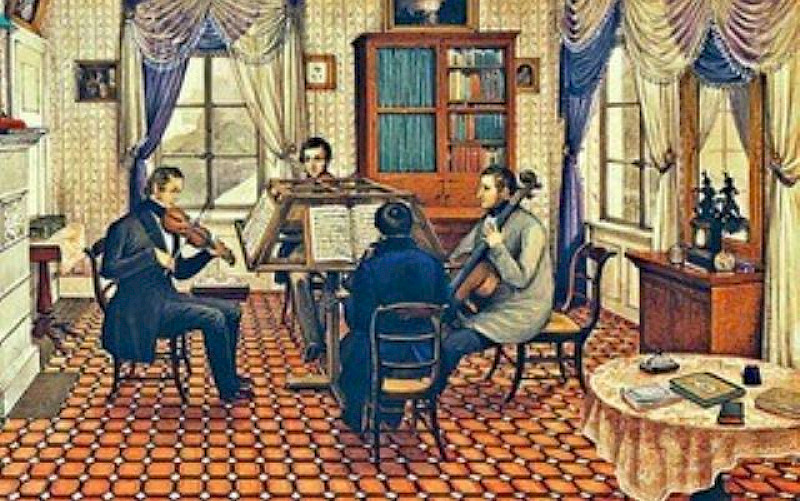
Conversations on Musical Visualisation and Memory
(Method of Loci - From Memory Technique to Creative Framework part 2)
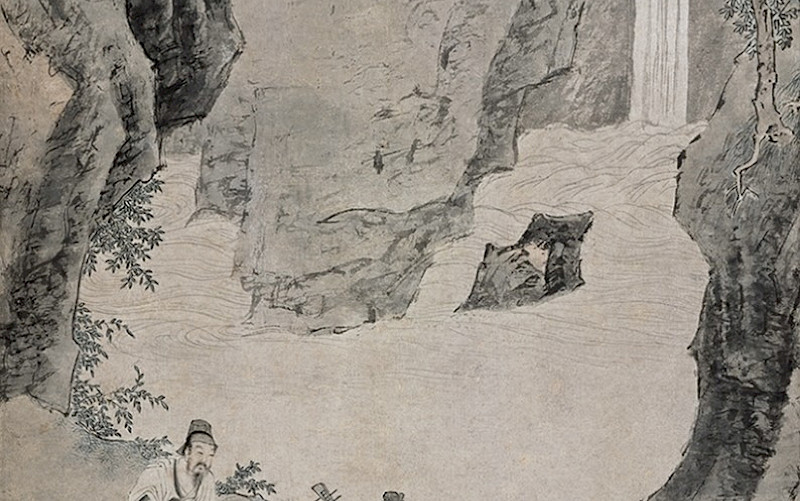
The Method of Loci, from Classical rhetoric, was used to memorise speeches, visualising a series of 'locations' containing images which represent what one wants to remember. The same method of visualisation in space could be used to recall subject matter related to specific topics ('locations') when writing. With an abstract art form such as music, can visualisation be used in a similar way, or are there other ways of representing musical information in the mind? How can imagery be associated with the sound and act of music making? And how can we use visualisation to 'plan' a performance or improvisation? These questions are discussed with reference to Medieval art, recorded interviews with experts, and a small practical experiment.
Michela Amici
Modulating on the harp
To what extent were improvisatory practices part of the pedal harp curriculum at the Royal Conservatoire of The Hague at the beginning of the 20th century and how can those practices inspire the next generation of harpists?
Dutch harp virtuoso and former Royal Conservatoire professor Rosa Spier (1891-1967) was known for her ‘bizarre’ approach against writing pedal changes in the score: “learn to think harmonically so that you don’t need to write in pedals!”. In this short presentation I will follow Rosa Spier traces to understand where this approach - closely tied with modulating and improvising on the harp - comes from, analyzing contemporary (Dutch) sources.
Guy Livingston
Re-sounding Modernist Heritage: The Royal Conservatoire’s Legacy in 20th-Century Avant-Garde Practice and its Integration into the Contemporary Piano Curriculum
The KC hosted a remarkable series of festivals in the 1980s and 1990s, welcoming avant-garde composers whose presence profoundly shaped the artistic outlook and careers of many students. My project explores the legacy around the composers who were invited for festival residencies at the KC in the 1980s and 1990s. (Kagel, Kurtag, Cage, Ligeti, Stockhausen, Messiaen). These festivals are not well-documented in the archives, but exist rather through the knowledge and memories of musicians who participated at the time, now many of them on the faculty.
Loes Rusch
Challenges and possibilities of (jazz)music education within the wider community
In this 45-minute discussion will explore the challenges and possibilities of higher jazz education, and music education in general. The aim of the discussion is to move beyond the daily practicalities to investigates the position of jazz/music education from a broader perspective. The discussion is a continuation of “It takes a Village,” the research project around Dutch jazz that was launched in October 2025, and engages with some of the questions that followed from it:
1) What defines (artistic) quality in jazz/music?
2) How can we (better) contribute to a sustainable jazzmusic village?
3) What can we do to connect our music/artists/projects to communities beyond the jazz ecosystem?
Riccardo Marogna
Bending Algorithms: Unorthodox Approaches to Digital Sound Synthesis
“In the 1940s and 1950s Elektronische musik and musique concréte were born by an unprecedented re-interpretation of technical instruments which were solely meant for scientific measurements and control. In that case, means of reproduction, control and storage were bent to a form of creative production - of poiesis - which was completely alien to their original technical code.” [Agostino Di Scipio, Questions Concerning Music Technology]
In the mid-1970s, at the Institute of Sonology, G.M. Koenig and Paul Berg adopted a similarly unorthodox view of the digital machine as an autonomous sound-producing system capable of generating novel, rich, and complex sonic results:
“ it became obvious to me [..] what I wanted to do. And that was ignoring science. And pay no attention to science, [..] and instead say: What is it that a computer can actually do, if you want to make sound?” [Berg interviewed by Arrantz, May 2009]
How might we draw inspiration from this legacy to explore new approaches to sound synthesis?
Digital technologies used in computer music originate in an engineering tradition. Although effective for designing scientifically robust algorithms, this tradition often prioritizes audio fidelity and technical “correctness” according to commercial standards — criteria that do not always align with the aims of experimental artistic practice.
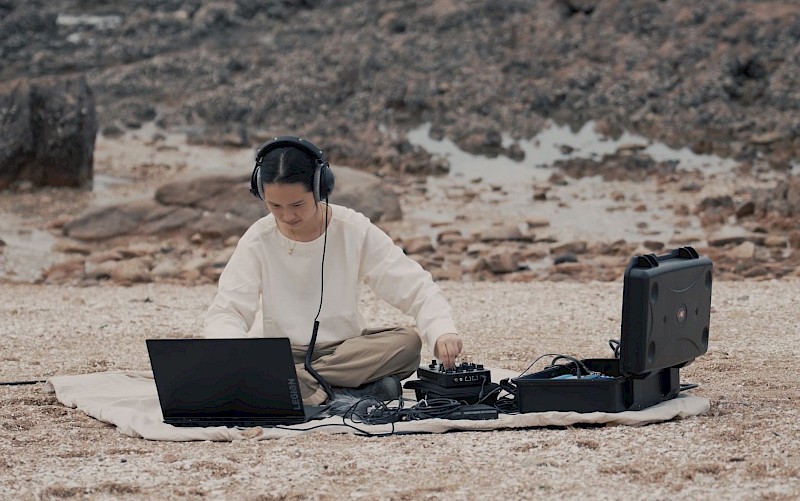
In this presentation, I will introduce a series of “unorthodox” sound synthesis methods developed through the deliberate bending, destabilization, misuse of DSP techniques. These approaches depart from conventional acoustically derived synthesis models and instead treat algorithms themselves as unstable creative material. I will discuss how these techniques differ from conventional synthesis approaches and demonstrate them in real time.
Pepe Garcia
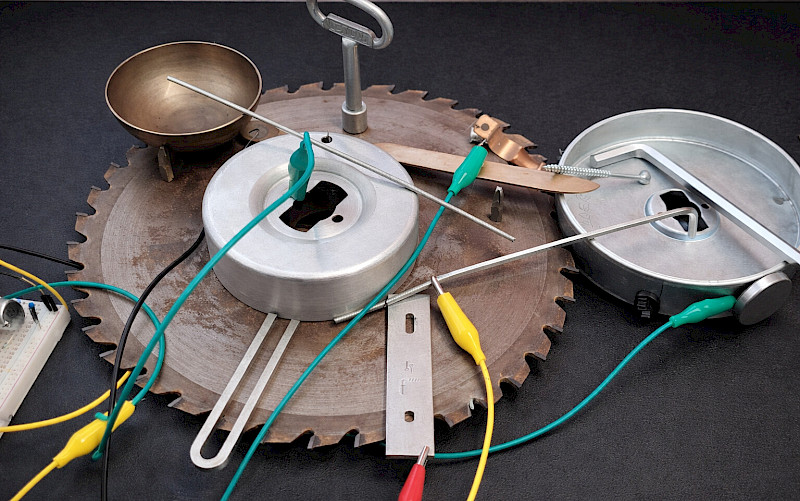
Live Demonstration: Sound Exploration with Found Materials
I will present how I work with previously gathered sound materials. I will analyze their sonic attributes-like pitch, texture, and dynamics-then demonstrate their use in two ways: first, improvising with them to test their flexibility, and second, applying them in a composed piece with open instrumentation. I’ll involve one or two students in the live process.