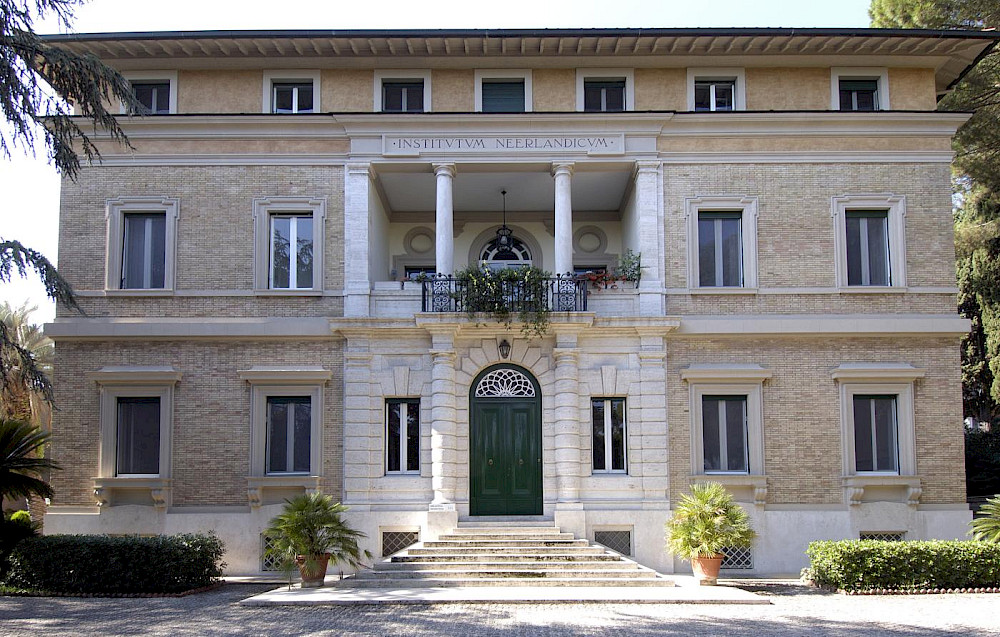
Artist-in-Residence Fellowship at the Royal Netherlands Institute in Rome (KNIR)
The Artist in Residence Fellowship in Rome is awarded to an artist who works for three months on a project that contributes concretely to the cross-fertilisation between art and academics. The programme is a collaboration between the Royal Netherlands Institute in Rome (KNIR) and the Society of Arts (Akademie van Kunsten).
The Artist-in-Residence programme offers one place for the academic year 2027-2028. The application period opens 1 September 2026, and closes 16 November, 12.00 CET.
What does the Artist-in-Residence programme entail?
The Artist-in-Residence programme is a collaboration between the Royal Netherlands Institute in Rome (KNIR) and the Society of Arts (AvK). It is a fellowship allowing artists to spend three months on a project that contributes concretely to the cross-fertilisation between art and academy.
Advanced students and researchers in the fields of classical studies, archaeology, art history and history work at the KNIR. They conduct research using a variety of methods in libraries, centuries-old archives, repositories, museums, archaeological sites and in the KNIR Lab for Material Culture Studies and Digital Analysis.
Cross-fertilisation, in terms of both subject matter and methodology, can yield interesting insights for both the researcher and the artist. In previous editions, artists integrated their performances into archaeological fieldwork (and vice versa); excavated skeletons in dusty storage depots were given a new status through artistic intervention; or the artist lent a new, personal dimension to historical research into fascism.
The aim is for the Artist-in-Residence to develop a topic into a final product – such as an essay, performance, film, visual art or other concept that can be made accessible to the public – through theoretical research.The residency at the KNIR is primarily intended as a period of research; during this phase, the Artist-in-Residence is not expected to have the final product already taking concrete shape.
The Artist-in-Residence programme offers one place for the academic year 2027-2028. The application period opens 1 September 2026, and closes 16 November, 12.00 CET.
About the KNIR
The Royal Netherlands Institute in Rome (KNIR) is an institute where advanced students and researchers work in the fields of antiquity and archaeology, art history and history. Research is carried out on the history of Rome and its relationship with the rest of world history. Currently, the focus lies on (cultural) imperialism and colonialism from antiquity until now.
About the Society of Arts
The Society of Arts is part of the Royal Netherlands Academy of Arts and Sciences (KNAW). The Society of Arts aims to represent the voice of the arts in Dutch society (including politics) and to promote interaction between the arts themselves and between the arts, society, and science.
Practical information
What does the Artist in Residence programme consist of?
- A stipend of € 1900 per month
- Temporary accommodation for three months (mid September to mid December) in a guest appartment at KNIR.
- Workplace and library facilities at the KNIR. No studios or studios are available
- A travel allowance (economy class) for return travel between the artist's residence and KNIR.
Participants are themselves responsible for paying taxes to the tax authorities or to the tax authorities of the country where they are tax liable.
Who is eligible?
- Dutch artists working in the Netherlands or abroad
- Artists of another nationality who live and work in the Netherlands
Nominating and application
- Members of the Academy of Arts can apply themselves
- If the artist is not a member of the Academy of Arts, he/she/they must be nominated by a nominator. Anybody can nominate a candidate. Self nominations will not be considered.
How does application work?
An application, written in English, must contain the following sections:
- Candidate's CV (maximum 1 page) with contact details, address and a list of achievements and recognitions (e.g. awards, exhibitions; the CV may include hyperlinks to projects or portfolio)
- Candidate's motivation letter (maximum 1 page)
- Research proposal written by the candidate including the proposed research, title, activities and intended results (maximum 1 page)
- If the candidate is not a member of the Society of Arts, a nominator's recommendation letter (maximum 1 page)
The nominator will send the above documents, merged into one pdf file, by e-mail to avk@knaw.nl, after Monday 1 September 2026, by Monday 16 November 2026, 12:00 noon.
Applications received before the opening of the application period or after the period has closed will not be considered.
Assessment criteria
Proposals will be assessed on:
- A clearly formulated research question in line with the objectives of the programme: contributing to cross fertilisation between art and science
- The candidate's motivation to contribute to the cross fertilisation between art and science in general
- The added value of a residency/research position at KNIR.
- The potential for dialogue with scholars working on KNIR research
- Feasibility of the project.
- A clearly specified work plan, research methodology and expected outcome
- A good command of the English language, as this is the academic language of the fellowship
Selection of a candidate
The KNIR director and the chairperson of the Society of Arts assess the competing candidates. Candidates are assessed against established criteria (see above). An interview may be part of the assessment process.
The decision to award an Artist in Residence fellowship is taken jointly by the KNIR director and the chairperson of the Society of Arts. If they cannot reach an agreement within a certain period of time, the board of the Royal Netherlands Academy of Arts and Sciences will decide.
No correspondence will be entered into regarding the selection committee's reasons for its choices, and no substantive comments will be provided on rejected research proposals.
What is expected of the Artist-in-Resicence?
- The residency includes regular presence in the KNIR library and participation in the activities taking place at KNIR, such as the weekly discussion evenings.
- As an extension of the research, the fellow organises an activity during the residency, e.g. a study day, exhibition, performance or expert meeting.
- The fellow ensures that a report of the research project is made available at the end of the fellowship. This report includes an explanation and appropriate visual material, and is intended for publication on the KNIR and Society of Arts websites.
- Within a year of the end of the residency, the fellow must initiate a public event about his/her/their project in cooperation with the KNIR and the Society of Arts.
Timeline
- Opening nomination period: Monday 1 September 2026 to Monday 16 November 2026, 12:00 CET
- First selection based on nominations: January 2027
- Interviews with candidates: February 2027
- Announcing final decision: March 2027
- Residency at KNIR: mid September 2027 to mid December 2027
Contact information
Do you have a question regarding the Artist-in-Residence fellowship? Please contact the Society of Arts at avk@knaw.nl
You can also find the call at https://www.akademievankunsten.nl/en/activities/artist-residence/artist-residence-knir